2.1 Course Theory and Rationale

LEARNING OUTCOME:
Mark this lesson COMPLETE (scroll to the end of the lesson) when you have achieved the following
I understand the Key Concepts listed at the end of this lesson and have completed a written response.
1. VIEW A RECORDING OF A RECENT WEBINAR
(NB: You can use the cog icon in the bottom right-hand corner to adjust the speed of the video)
2. READ A WRITTEN EXPLANATION
A Brief History of Comprehension Instruction
Traditionally, comprehension skills were developed by asking the learner lots of questions. It was assumed that if we, the teacher, modelled the higher order thinking that was required to understand text, then eventually the reader would learn to do that for themselves.
In the 1990s, we became aware of comprehension strategies and have since generated long lists of metacognitive strategies that are often taught in a haphazard manner with varying degrees of impact on our learners.
“Most approaches to comprehension instruction revolve around equipping the learner with many strategies (intentional actions students can use during and after reading to guide their thinking) which the student then selects from and applies to problem-solve comprehension issues.”
We think there is a sharper way to develop skilled comprehenders.
Recent Research (The Science of Reading)
The last two decades have provided us with many new insights into the way the brain functions when reading, and we now have increasingly complex models which describe this process. SharpReading aligns well with these models.
What must be remembered when considering Models of Reading is that they describe what we have learnt happens in the brain. That should inform our teaching, but the models don't provide us with the 'How do we teach that?' (Timothy Shanahan)
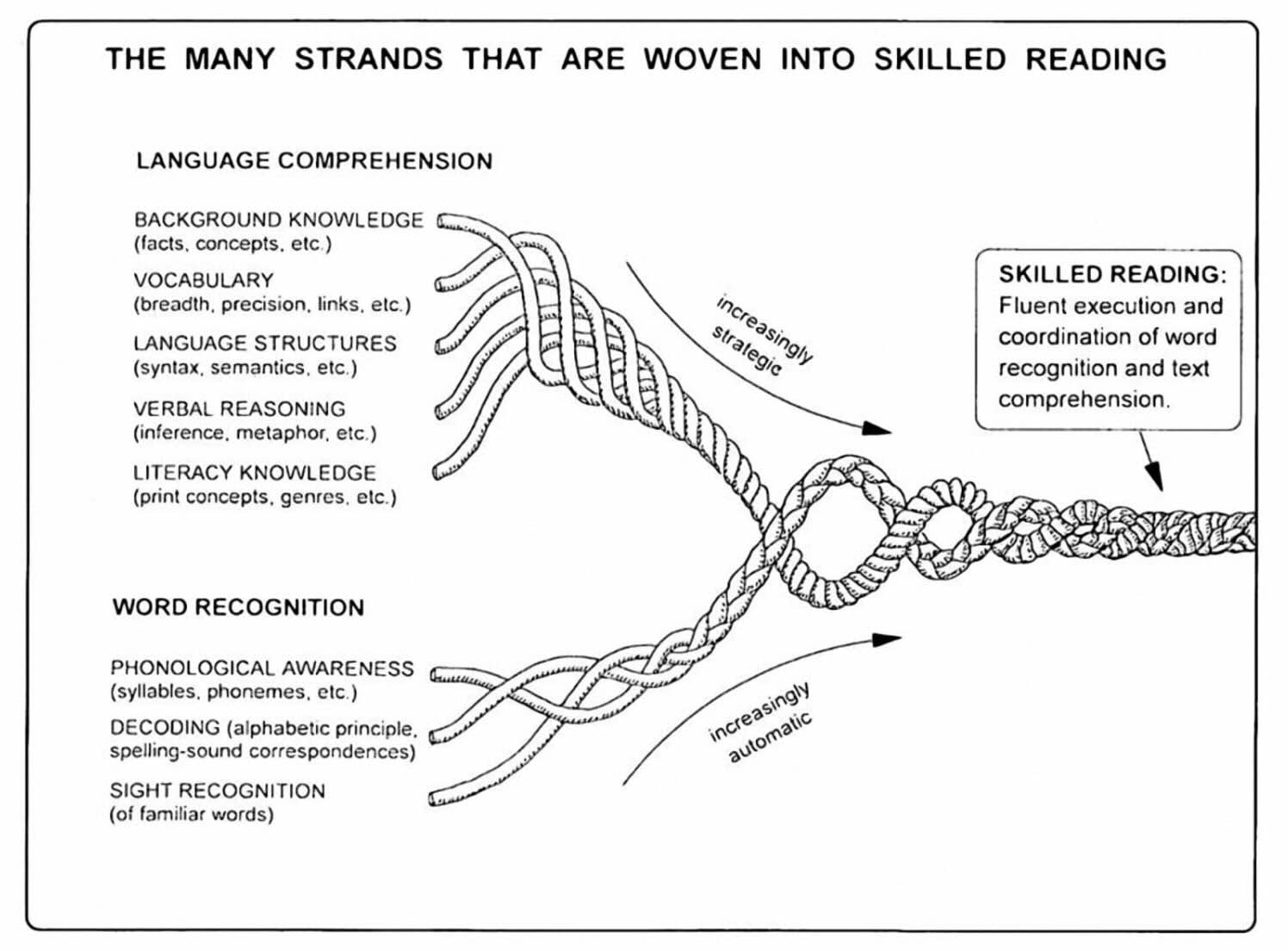
But for the sake of simplicity, we are going to base our comments here on one particular model that has stood the test of time, Scarborough’s Rope from 2001, which provides an excellent but not overwhelmingly complex framework for comprehension instruction.
Scarborough's Rope (2001)
As you can see, the two distinct parts of the rope demonstrate a well-understood distinction in the skill sets required to be a skilled reader.
Word Recognition Skills
The starting point of any approach to reading instruction must be to develop word recognition skills. It must be noted that reading is not a naturally acquired skill like walking or talking. It is a man-made construct and, as such, requires much drilling in the use of a code that, once learned and mastered, becomes increasingly automatic. Developing this decoding fluency is the focus of SharpReading Stages 1&2.
Learning the code requires an enormous amount of cognitive energy. It is only as the reader approaches decoding fluency that the brain is freed up to focus on text comprehension, the other significant rope in Scarborough's model.
Language Comprehension Skills
This is the focus of Stage 3 and provides the foundation for Stages 4-6.
This is a skill set that has been developing intuitively from birth.
Breaking down the Language Comprehension strands
BACKGROUND KNOWLEDGE - The child gains understanding of the world around them as they experience it and interact with it.
VOCABULARY - They learn words to label objects and their experiences and store these in their long-term memory. The average 10-year-old has 10,000 words locked away.
LANGUAGE STRUCTURES - The child begins to understand how these words are put together to communicate ideas.
VERBAL REASONING - They learn to sift through these words and sentences and make judgments about the subtleties of meaning. They learn how to 'read between the lines' (make inferences) and begin to distinguish between the literal and symbolic use of language.
LITERACY KNOWLEDGE - As they are exposed to the language of written text, they discern the difference between spoken and written language and different genres and writing styles.
Skills or Strategies?
Here, we think it is important to make a distinction between comprehension skills and the comprehension strategies mentioned earlier.
A musician practises their craft until it is an automatic response, something they no longer have to consciously think about. This is the definition of a 'skill'. These five aspects of language comprehension require that sort of automatic response, the development of language comprehension 'skills'. This is quite different from the teaching of 'intentional actions students can use during and after reading to guide their thinking' (strategies).
We introduce strategies in Stages 4-6, but in Stage 3 we want to polish the use of these language comprehension 'skills'. If we extend the analogy of the musician to that of an orchestra, we could say that the highly skilled comprehender combines the use of these skills in much the same way as an orchestra performs. The background knowledge could be likened to the string section, vocabulary the woodwinds, verbal reasoning the brass section etc. At different times, they have different roles in the piece that is being played, but they all combine to create a harmonious result.
The brain research tells us that it is the application and flexible collaboration of these skills that determines the level of initial comprehension or meaning that the reader will extract from any text they are reading.
The ability to 'be the orchestra' that our students will bring with them as they present themselves in our classrooms has been 5-7 years in the making. It will vary considerably from student to student, depending on their innate cognitive ability and the experiences of the world and exposure to text that they have accumulated.
Our very good readers may well have intuitively developed some collaborative use of these skills. However, in my experience, and by their own admission, even the more able readers tend to skate over the meaning of what they are reading and 'grab a bit here and a bit there' without attending to the detail.
We refer to this as a passive reader mindset; great decoders, fast readers, but unfamiliar with the deep processing of text. The orchestra has some sections that need polishing.
Others, while reasonable decoders, have little awareness of processing the meaning of what they have read and are dependent on someone asking them questions to initiate constructive thought. A very limited orchestra.
So, how do we develop the orchestra?
What not to do
A natural response would be in-depth teaching of these language comprehension strands: inferencing, grammar, language features, genre, or just focusing on building vocabulary and general knowledge, and then hoping that the learner can transfer what they have learned into their construction of meaning as they read.
Of course, being aware of these components should encourage us to actively promote them during the smorgasbord of activities that occur during the day. Your science and social studies curriculum will be loading them up with new content, you can explore interesting vocab throughout the day, take a moment to discuss idiom and figures of speech, and bring some understanding of sentence structure and grammar into their written language.
BUT, the research does suggest that this will not easily or necessarily transfer into the students' ability to construct meaning while they are reading.
But there are two important considerations.
1) The goal is to put together a meaningful, coherent instructional reading program.
If you devote ALL of your instructional time to polishing the strands, you will get back to 'a bit of this and a bit of that' teaching, hoping it will all come together and transfer into what the reader does WHEN they are reading.
2) The act of comprehension requires great cognitive flexibility to meet the unique challenges in every sentence, rather than an ability to apply a set of rules. The landscape changes with every sentence, and so do the range of language comprehension skills that need to be applied.
Here is an example. "Denise was stuck in a jam, and she was worried about what her boss would say."
How do we apply the Language Comprehension strands to understand what is going on in this sentence?
Vocabulary knowledge provides the building blocks of comprehension, but it’s not just a matter of being able to read the words. Here, the word jam refers to traffic, not the fruit preserve. The unfamiliar word Denise has to be recognised as a name, and there is a need to analyse words which appear in a complex form, such as worried.
Language structures - Causal connections need to be made within the sentence to understand that she and her in the second part of the sentence refer to Denise in the first part of the sentence.
Verbal Reasoning - to fully understand the action, inferences will be made based on the reader's background knowledge. Denise was probably on her way to work but was running late because of heavy traffic. How does she travel? Is she in a car or on a bus? Perhaps she has been late several times recently and is thus especially worried about her boss's reaction; maybe she is worried because she will be late for a meeting.
These are potential elaborations that are licensed by this particular sentence.
Our Solution - Unpacking Sentences
We think, given the lesson time constraints in our classrooms, that the best way to develop mastery of these skills is to provide a simple, structured routine that allows the learner to have a go at integrating this skill set again and again and again.
Our routine provides the opportunity for explicit teaching (Explain, Model, Guided Practice) of any aspect of the Language Comprehension domain, but the main focus is on Independent Practice of Unpacking Sentences. This is the chance to learn by DOING it. Integrate all the strands. Get the orchestra playing! The musician learns much more from having to collaborate than by practising a part in isolation.
'The band gets better by playing together'.
'Can you convince me that you know what is going on in that sentence?' (the success criteria for unpacking sentences) forces the reader to monitor their comprehension and attend to the bits they don't get. By carefully selecting the level of text difficult,y we ensure that the comprehension challenges they face are manageable and they can problem-solve their way out of them, gaining confidence and satisfaction from their newly acquired comprehension skills.
The Key to Training the Brain: Say it out loud!
With all our SharpReading stages, oral sharing of the thinking required to unpack a sentence allows the speaker to see how blurred their thinking is and then sharpen it. Vague mental responses float around in the mind while reading is taking place. When the reader is asked to verbalise their thinking, a different part of the brain is activated, which facilitates the transfer of information from short-term memory into long-term memory and helps to develop strong thinking pathways and robust active reading habits.
USE IT OR LOSE IT
There is no obvious accountability built into this course design (there are no assignments or exams), but we do ask you to take a few moments to consider the following questions and make short responses to them on the back page of your course book. That will provide a useful summary of the main points as an easy-access reference. It will also go a long way towards transferring these concepts into your long-term memory - USE IT OR LOSE IT!
ONCE YOU HAVE MADE A CONSCIOUS EFFORT TO ANSWER EACH QUESTION, click on the shaded text box for the answer.
1. What do we mean by 'First, you must be a fluent decoder'?
Decoding fluency is an important prerequisite to Stages 3-6 comprehension instruction. Word recognition needs to be automatic so that the working memory is not clogged by decoding requirements and is free to engage in deep processing of the message in the text.
2. Snow summarises reading comprehension as two actions that occur in the brain. What are they?
Extract the ideas (often phrases) from the sentence and then put them together (construct the meaning the author intended).
3. What are the 5 strands of the language comprehension rope?
Background Knowledge, Vocabulary, Language Structures, Verbal Reasoning, Literacy Knowledge.
4. What do we mean by ‘The band gets better by playing together’?
Some explicit teaching of the language comprehension strands is useful, but the research suggests that the best way to develop the flexible use of these skills is to practise them in a meaningful context - unpacking sentences.
5. What is ‘The Idea Grab’?
This occurs when the reader is unaware of the requirement to attend to ALL the information in a sentence (the passive reader) or is overwhelmed by the flow-on effect of all those words. As a result, they just grab something (anything) from the sentence and end up with a weak situation model.
6. What do we mean by ‘In-the-moment Comprehension’?
In-the-moment Comprehension occurs automatically in the head of the reader as a result of the interaction of the language strands.
7. What do we mean by ‘Stop-and-think-about-it Comprehension’?
Stop-and-think-about-it comprehension refers to deliberate, metacognitive actions that the reader can take to solve comprehension difficulties that arise or to deepen understanding.
8. What is the main focus of Stage 3?
Developing ‘In-the-moment’ comprehension skills before moving on to strategies.
9. Why do we ask students to verbalise their thinking while unpacking sentences?
It forces the reader to clarify the thoughts that have been triggered by the words. It helps to develop an active reading habit.
Once you have completed this task, mark this lesson as COMPLETE.
REFERENCES for additional reading if you want to dig deeper.
Willingham, D. (2017). The reading mind: A cognitive approach to understanding how the mind reads. San Francisco, CA: Jossey-Bass.
Anne Castles, Kathleen Rastle, Kate Nation, (2018) "Ending the Reading Wars: Reading Acquisition From Novice to Expert" https://journals.sagepub.com/doi/10.1177/1529100618772271
Timothy Shanahan and Brandon Harvey (2021), 'Models Behind the Science of Reading'
https://medium.com/inspired-ideas-prek-12/dr-timothy-shanahan-on-the-models-behind-the-science-of-reading-94043ad4018c
NEXT: What does a SharpReading classroom literacy block look like? (2026 Update)
We provide what we think are the essential components of a whole-class reading program and how to manage those components within the 'literacy block' in your timetable.
And then on to the practical - Units 3 and 4: Explicit Teaching and Independent Practice of Unpacking Sentences.