2.2 The Components of a SharpReading Comprehension Literacy Block

LEARNING OUTCOME
Mark this lesson COMPLETE when you have done the following
I have read the chart and the supporting information and am aware of the SharpReading possibilities.
SETTING THE SCENE
Here is a breakdown of the different teaching and practice modes that you can use in the classroom to achieve your reading comprehension outcomes.
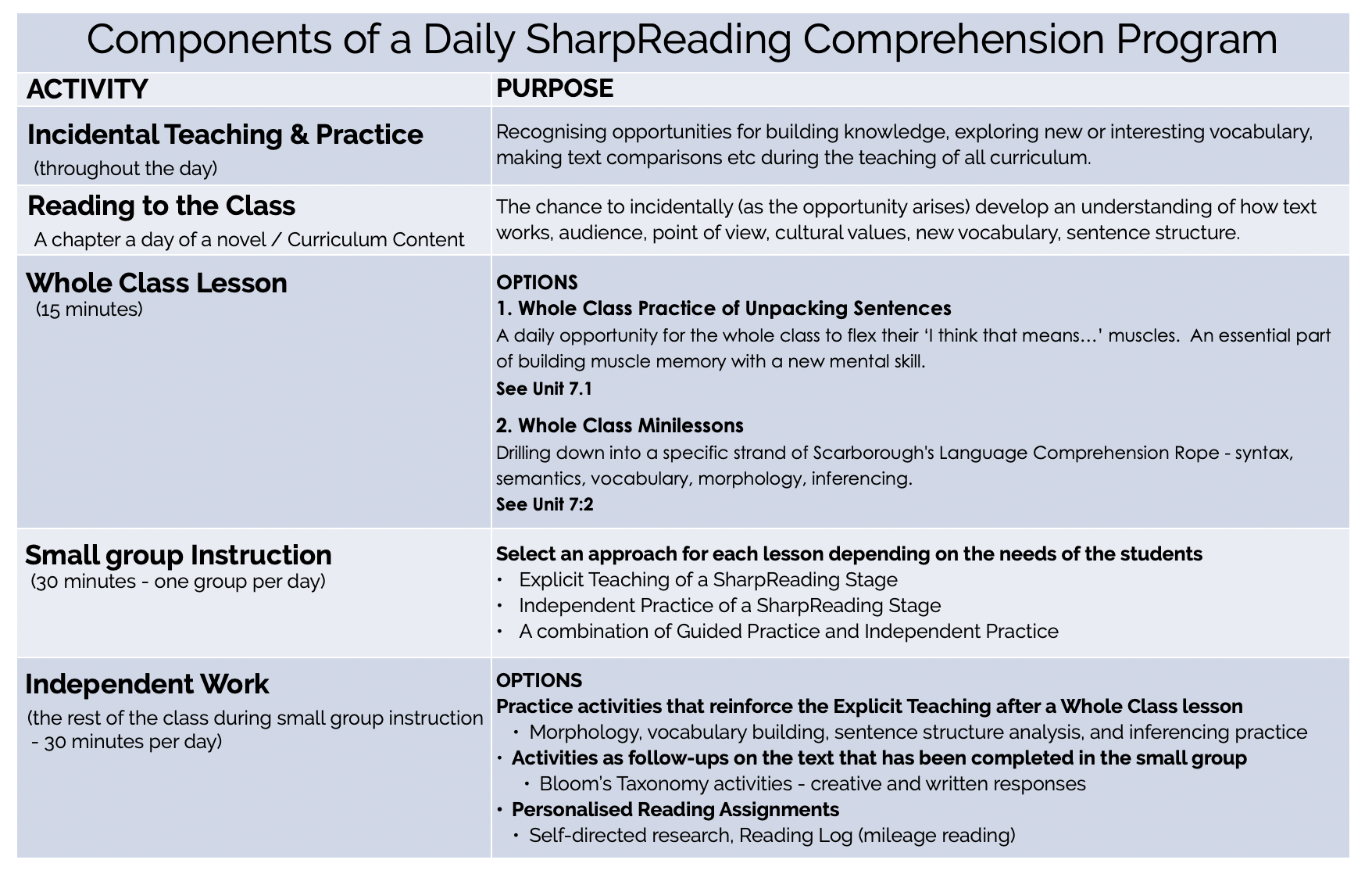
Incidental Teaching & Practice (throughout the day)
Once you are alert to the possibilities for developing language comprehension skills, you will find many opportunities during the teaching of all curriculum for building knowledge, exploring new or interesting vocabulary, reflecting on author intentions, identifying interesting or challenging sentence and text structure, and making text comparisons.
Reading to the Class
Schedule regular 10-15 minute blocks during the day where you read to the whole class OR when you have some time to fill between programmed classes.
A chapter a day of a novel or some curriculum content
Often, this will be a more sophisticated text than what the readers can access by themselves
Use this as an opportunity to develop your students' understanding of how text works: audience, point of view, cultural values, new vocabulary, and sentence structure, as the opportunities arise in the text.
Whole Class Lesson (15 Mins)
There are two possibilities
-
Whole Class Practice of Unpacking Sentences using enlarged text (StoryBytes & InfoBytes powerpoints).
The opportunity for the daily practice of ITTM (one paragraph) helps establish mental habits.
See Unit 7.1 for full details and Teacher Script
- Guided Practice and/or Independent Practice -
Whole Class Minilessons
Drilling down into a specific strand of Scarborough's Language Comprehension Rope and working through a Scope and Sequence.
This provides tools for unpacking sentences.
See Unit 7:2 - we will be adding series of minilessons as they are developed
AVAILABLE VERY SOON (March at the latest)
-
Syntax - building syntactical awareness
Sentence combining and deconstruction modelling & activities
Identifying Who, What, When, Where, and How activities
TO BE ADDED TO UNIT 7 in 2026
-
Vocabulary Instruction
Extending Vocabulary strategies - How to clear roadblocks
Teach new vocabulary - build word generalisations (Semantics)
-
Verbal Reasoning
Teach & Practice Inferencing
Teach & Practice local coherence
Teach figures of speech
Morphology - affixes and root words
Knowledge - building domain knowledge in a content area
Small Group Instruction (30 mins) - Your Reading Rotation
For more information, go to Unit 1: APPENDIX 1 'Setting up a Reading Rotation
Unit 3: Explicit Teaching Routine for Unpacking Sentences (small group)
Unit 4: Independent Practice Routine for Unpacking Sentences (small group)
THIS IS THE HEARTBEAT OF YOUR READING PROGRAM!
Efficient comprehension is dependent on the reader's cognitive ability to integrate and synthesise the Language Comprehension strands from Scarborough's Reading Rope WHILE they are reading. SharpReading provides a well-structured small group routine that allows the reader to build that capacity in a manageable way.
Move between Modelling, Guided Practice, and Independent practice of the SharpReading routine based on the needs of the group and the SharpReading Stage you are working on.
Independent Work - activities for the rest of the class while you are busy with small group instruction (30 minutes a day).
After Reading activities provide the opportunity for students to revisit texts they have read and consolidate the language comprehension skills that they are developing while reading.
Stages 3-6 group instruction provides many opportunities for written activities.
Select from a range of possibilities
-
Practice activities that reinforce the Explicit Teaching from a whole-class lesson
Morphology, vocabulary, sentence structure, and inferencing practice
-
Activities as follow-ups on the text that has been completed in the small group OR the class READ ALOUD
Can be based on Bloom's Taxonomy for the practice of skills associated with the different SharpReading Stages
For more information and activities based on Bloom's Taxonomy, go to Unit 1: APPENDIX 1 'Setting up a Reading Rotation'.
Novel Study activities
Personalised Reading Assignments
Self-directed research, Reading Log (mileage reading)
Written Language Assignments - your reading lessons may provide a lead in to these.