- Nov 13, 2024
When is the reader ready for Comprehension Instruction?
- Hilton Ayrey
- 0 comments
If you interpret comprehension instruction as helping the reader to understand how text and stories work then it would be true to say that this process can, and should, begin as early as possible. I do this all the time with my 2 and 3 year-old grandchildren.
However, this is not what we mean when we talk about the deliberate training of the brain to process the meaning of text while the reader is reading.
Our take on this is summed up in our SharpReading developmental progression which recognises a significant constraint that need to be recognised when designing an instructional reading programme.
Before the reader can truly engage in the act of deep comprehension of the text they are reading, while they are reading it, they need to be a fluent decoder.
Michael Pressely said, “When a reader slowly analyses a word into component sounds and blends them, a great deal of cognitive capacity is consumed with little left over for understanding the overall meaning of the sentence, let alone the meaning of the word.” (Pressley 2015).
Here is an interpretation of what the cognitive scientists have determined is going on in the working memory of the early reader.
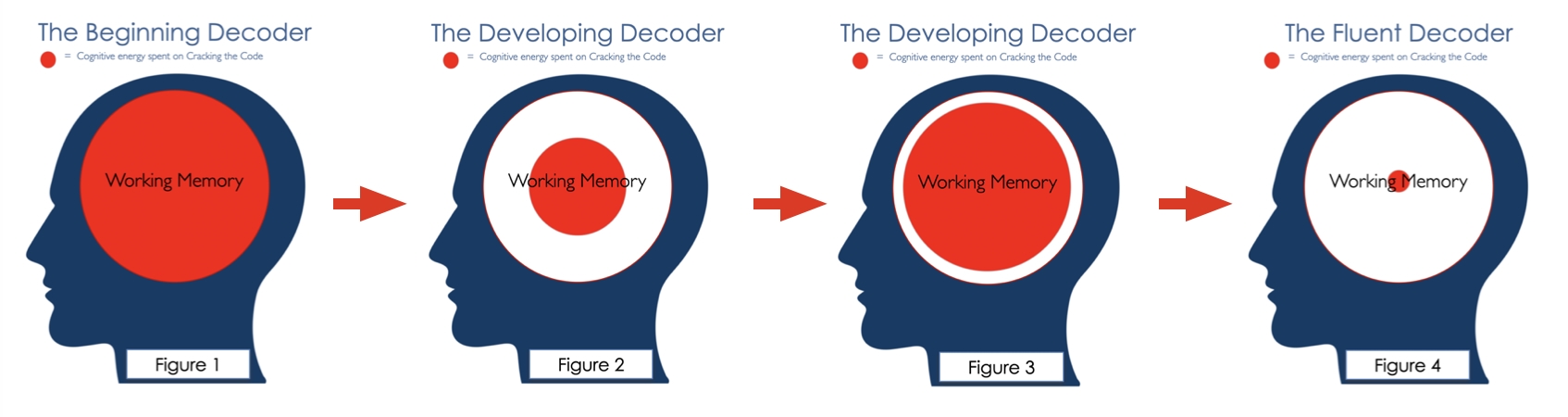
Figure 1: The Beginning Decoder
The reader has been told that the squiggles on the page in front of them are representations of the words that they know from the oral exposure they have had to conversational and book language. As Pressley says, the working memory (the processing part of our brain) is totally engaged with searching for familiar shapes and patterns.
Figure 2: The Developing Decoder
With the help of ongoing phonics instruction, the stress in the working memory reduces as some of the learned skills kick in. The reader is experiencing success with an increasing number of letter sounds and letter patterns.
Figure 3: Extending the Developing Decoder
Familiar letter patterns are now enabling the brain to store an increasing number of words into the long term memory for quick and easy retrevial through orthographic mapping. So we increase the complexity of the text (syntax and vocabulary) to build this developing decoding capacity. The result is that the working memory is still fully engaged by this process.
Figure 4: The Fluent Decoder
The reader has now absorbed enough of the code so that word recognition is becoming increasingly effortless. There will be one or two words on a page that will require the application of some phonics strategies, but the working memory is now being freed up from word decoding.
Once the reader shows that they can cope with the presentation of increasingly complex multisyllabic words that appear in text at a reading age 7-8 years and above we say that they have achieved 'Decoding Fluency'.
NOW the brain is ready for comprehension instruction.
Stages 1&2: "Developing Decoding Fluency"
Stage 3: "Teach Comprehension Skills"
References:
Pressley, M, "Reading Instruction that works" 2015. New York:The Guilford Press