- Feb 4, 2025
SharpReading meets Structured Literacy
- Hilton Ayrey
- Comprehension
- 0 comments
Here in NZ this week the rubber is meeting the road as schools look to align themselves with the government's edict that all schools implement a Structured Literacy approach to literacy instruction in 2025.
We are all trying to get our heads around what that means for our classroom programmes.
This blog is me trying to clarify some terms.
What is Structured Literacy?
The International Dyslexia Association (IDA) coined the term in 2014 and defines structured literacy as the "highly explicit, systematic teaching of foundation literacy skills such as decoding and spelling skills, as well as explicit teaching of other important components of literacy such as vocabulary, comprehension, and writing".
There is a set of principles that guide how Structured Literacy elements are taught
1. Instruction must be Systematic and Cumulative.
Systematic means that there is a well-organized sequence of instruction, with important prerequisite skills taught before more advanced skills. The sequence begins with the easiest and most basic concepts and elements and progresses methodically to the more difficult.
Cumulative means each step is based on concepts previously learned.
So...how does that line up with SharpReading?
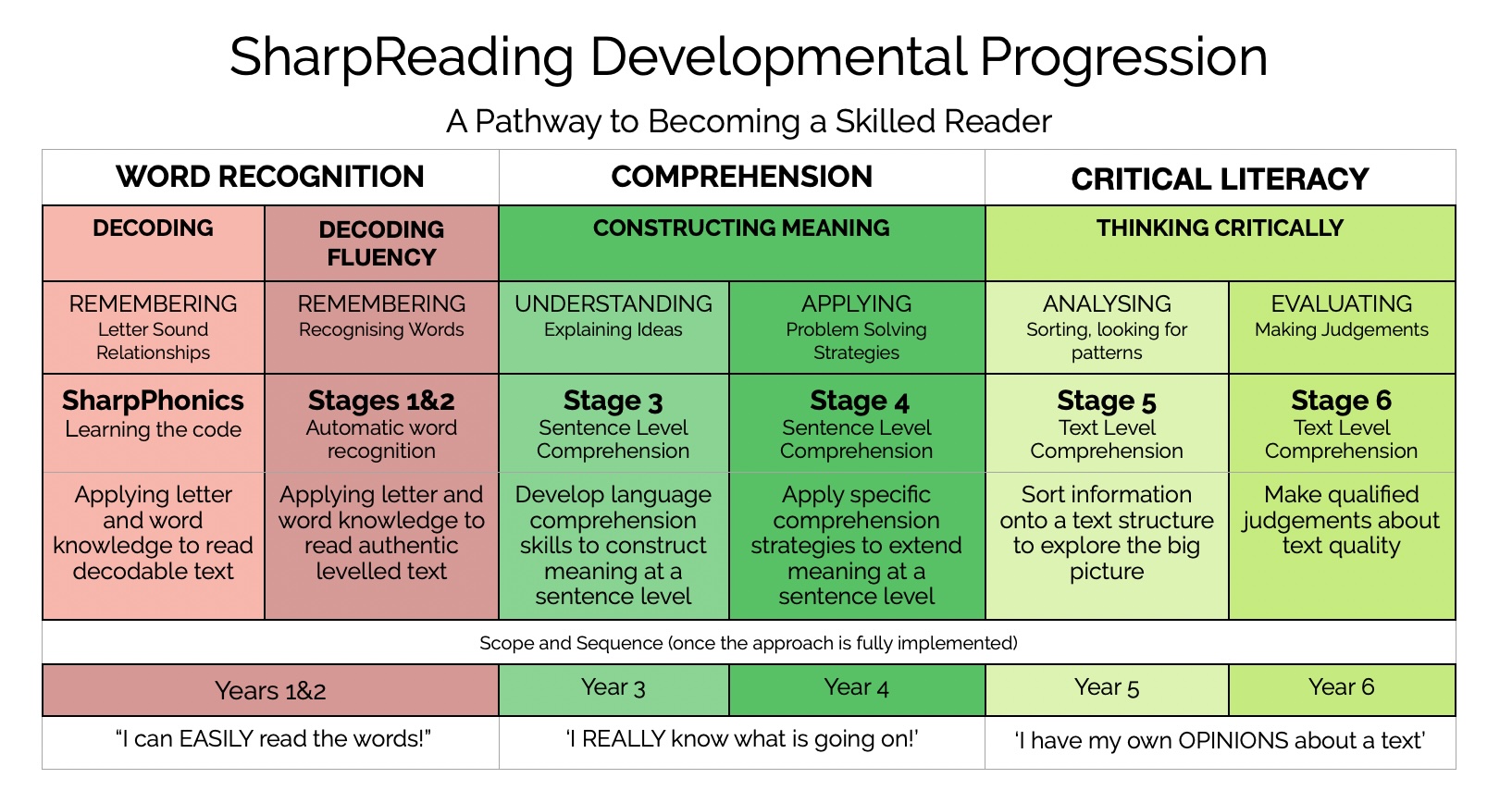
Our SharpReading developmental progression shows how we interpret that. As the student moves from the left to the right, the stages encompass increasingly more complex cognitive requirements for the learner as indicated by Bloom's Taxonomy (Remembering, Understanding, Applying, Analysing, Evaluating). Each stage provides a foundation for the next.
2. Literacy Concepts and Skills must be taught Explicitly
Structured Literacy instruction requires direct teaching of concepts. Teachers clearly explain and model key skills; they do not expect children to infer these skills only from exposure.
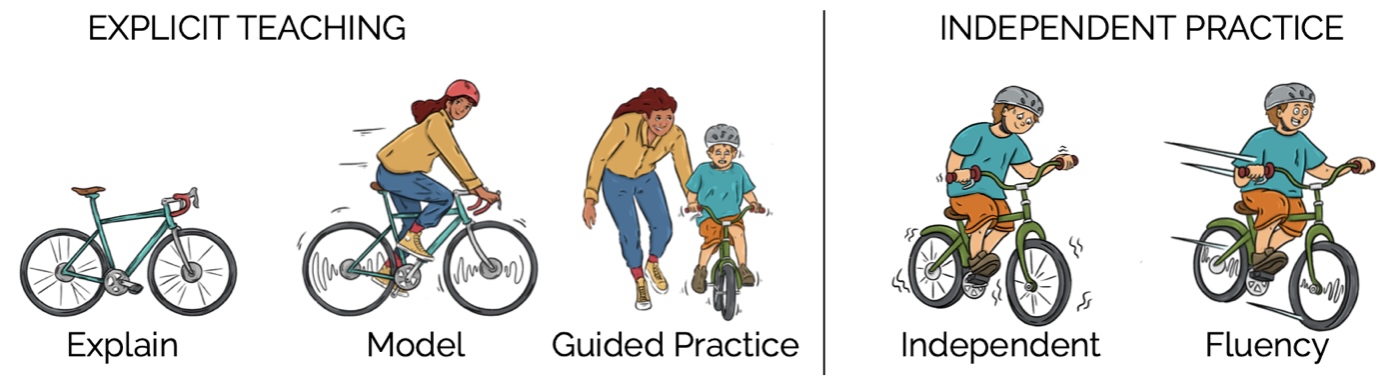
All of our SharpReading courses incorporate an Explicit Teaching model of instruction - Explain, Model, Guided Practice, Independent Practice to Fluency - with a clear Scope and Sequence for each stage.
3. Instruction must be Diagnostic and Responsive
Teachers must be adept at individualizing instruction (even within groups) based on careful and continuous assessment, both informal (e.g., observation) and formal (e.g., with standardized measures). Content must be mastered to the degree of automaticity needed to free attention and cognitive resources as the student moves through Decoding, Constructing Meaning and Critical Thinking.
No problem with that! Our routines are designed to allow teachers to monitor how well students are transferring the skills they have been explicitly taught into authentic reading situations. This abundance of observable data guides their next learning step. We are great advocates of Cognitive Load Theory (Sweller).
At this point, It should be noted that Structured Literacy was originally a programme designed for dyslexic readers. It is important that it should not be viewed as a 'one-size-fits-all' approach and that students are exposed to the concepts they need and taught at a pace that is appropriate.
Here is a very useful infographic from one of the prominent researchers in the field of Structured Literacy, Nancy Young. It is a good reminder!
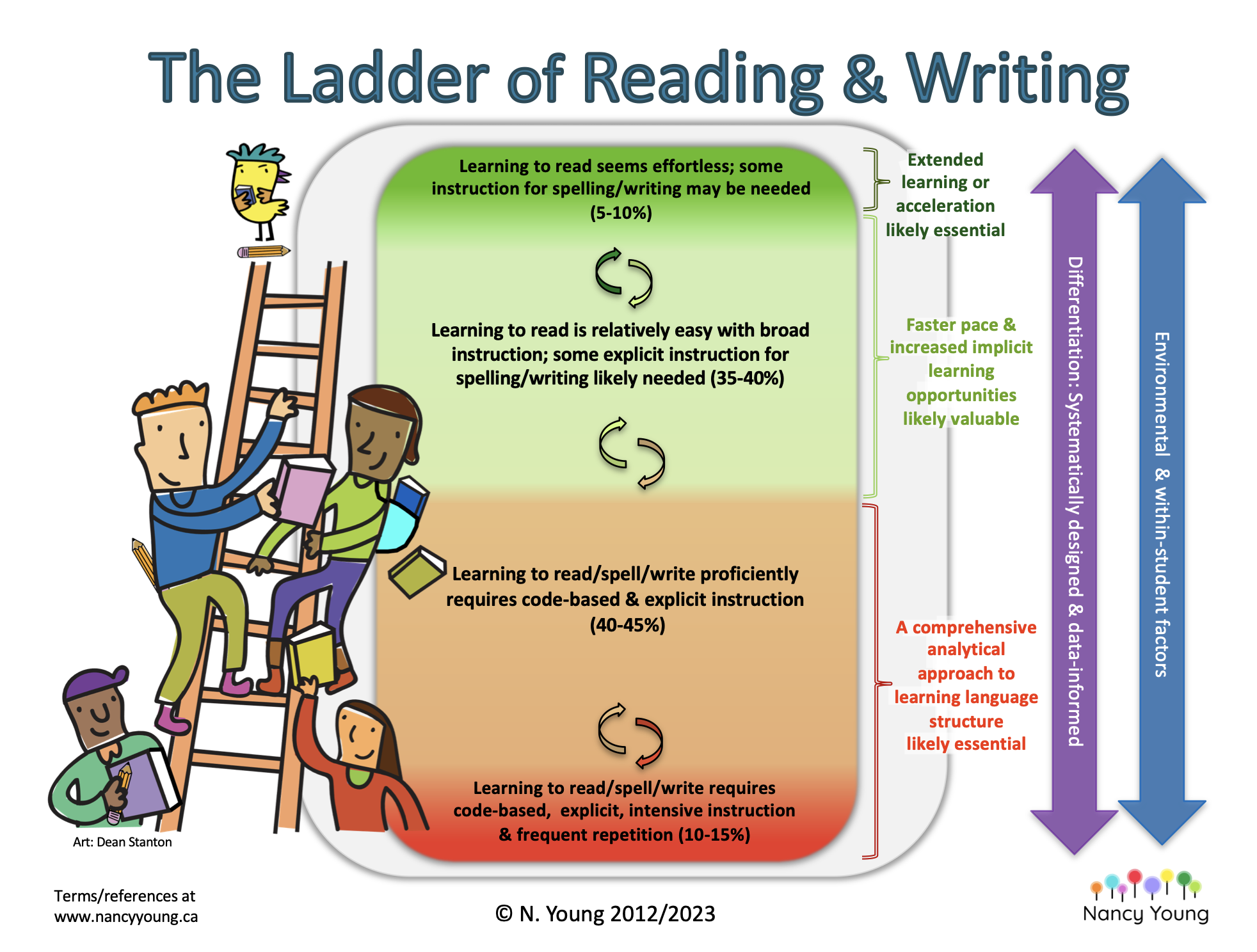
DARK GREEN ZONE
Learning to read seems effortless and these students require advanced learning opportunities to keep them moving forward.
LIGHT GREEN ZONE
These students will move forward with broad instruction for reading, and some explicit instruction for spelling and writing.
ORANGE ZONE
These students require code-based instruction but it is likely tobe less intense and faster-paced.
RED ZONE
These students require intensive explicit code-based instruction with frequent repetition
So that deals with the Methodology of Teaching. What about the Content?
Instruction in Structured literacy covers the following concepts:
Phonology: the study of sounds in spoken words
Sound-symbol (orthography): how to map sounds (phonemes) to letters (graphemes)
Syllables: knowing the types of syllables and how to divide words into syllables
Morphology: the study of base words and affixes (prefixes and suffixes)
With a SharpReading approach, these four concepts form the basis of the first three years of literacy instruction and are covered by a robust phonics programme and SharpReading Stages 1&2: 'Developing Decoding Fluency'. We do have SharpPhonics as a phonics programme but there are many variations on this that all do similar things.
Syntax: understanding the grammatical order of words (sentence structure)
Semantics: understanding the meaning of words and sentences (vocabulary)
While these two concepts will receive some attention in SharpReading Stages 1&2, we think that Stage 3 is where the heavy-lifting is done on Syntax and Semantics. This is the beginning of comprehension instruction.
The prerequisite is that the reader is a fluent decoder, and the working memory is now free to address properly the development of the active reading mindset. Students who may be passive comprehenders (they just grab ideas and form weak situation models as they skim through sentences) are now required to train their brains to attend to all the ideas and concepts in the sentence and through an understanding of semantics and syntax, accurately construct the message that the author intended.
Beyond the development of these automatic comprehension skills, the reader learns to apply stop-and-think-about-it metacognitive strategies (Stage 4) and then move on to sentence and paragraph analysis (Stage 5) and evaluation (Stage 6) of text.
How does this match up with your experience of Structured Literacy?
Feel free to make a comment.